When students first encounter square roots and cube roots, the numbers rarely come out perfectly. Most radicals are irrational, meaning their decimals go on forever without repeating. An estimation of radical expressions practice sheet gives learners a structured way to figure out roughly how big these numbers are without relying on a calculator. Building this skill early helps students develop a strong intuition for number sense, which is essential for higher-level algebra and geometry.
What exactly are we estimating?
When you look at a number like √50, you know it is not a whole number. The goal of estimation is to trap that radical between two consecutive integers. Since 49 is a perfect square (7 × 7) and 64 is the next perfect square (8 × 8), √50 must be slightly more than 7. A good practice sheet walks students through this bounding process step-by-step, moving from simple integer approximations to more precise decimal estimates.
When do students actually need this skill?
You might wonder why we bother estimating when phones have built-in calculators. Standardized math tests frequently ban calculators for specific sections to check if students truly understand the concepts rather than just pushing buttons. Beyond testing, approximating roots is highly practical in geometry. If you are using the Pythagorean theorem to find the length of a hypotenuse and get √130, knowing instantly that it is roughly 11.4 helps you verify if your physical measurements make sense.
Teachers often introduce this concept through an engaging approximating irrational numbers activity to make the abstract idea of infinite decimals feel more concrete for middle schoolers.
How should a practice worksheet be structured?
A highly effective worksheet does not just list 20 random problems. It should guide the student through a logical progression. Start with a reference chart of perfect squares from 1 to 225. Next, include number line exercises where students physically plot the radical between two integers. Finally, move to word problems that require rounding to the nearest tenth.
If you are designing your own practice sheets to print for a classroom, readability is key. Using a clean, highly legible typeface like Montserrat ensures that numbers and radical symbols do not blur together, which is especially helpful for students with visual processing difficulties.
What are the most common mistakes students make?
Even with a solid worksheet, students tend to fall into a few predictable traps.
- Dividing instead of rooting: A student sees √36 and calculates 36 ÷ 2 = 18 instead of finding the number that multiplies by itself to make 36.
- Linear interpolation errors: When estimating √50, students might assume it is exactly halfway between 7 and 8 because 50 is roughly halfway between 49 and 64. Square roots do not scale linearly, so √50 is actually much closer to 7.1.
- Ignoring the negative root: In algebra, equations like x² = 25 have two solutions (5 and -5). Practice sheets often forget to remind students about the negative counterpart unless specifically asked for the principal root.
How can students improve their mental math for radicals?
Memorizing perfect squares up to 15² (225) or 20² (400) is the non-negotiable first step. Once those are locked in, students can tackle more complex estimations. Working through targeted square root estimation problems with integer approximations helps build the mental muscle needed to quickly narrow down the bounds of an irrational number before trying to guess the decimal.
For advanced learners who want to push their skills further, trying a strict without calculator square root estimation challenge forces them to rely entirely on number sense and logical deduction rather than digital shortcuts.
Next steps for mastering radical estimation
Ready to put this into practice? Follow this quick checklist to build a solid routine:
- Print a reference chart of perfect squares and cubes and keep it visible during homework.
- Complete five bounding exercises daily, identifying the two closest integers for a given radical.
- Draw a number line to visually plot three different irrational numbers each week.
- Check your manual estimates with a calculator only after you have written down your final answer to track your accuracy over time.
Consistent practice is the only way to make these mental shortcuts stick. Keep your perfect square chart handy, and soon estimating radicals will feel just as natural as basic multiplication.
Try It Free Quick Methods for Mentally Approximating Square Roots
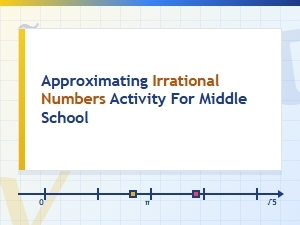 Mental Math Strategies for Approximating Irrational Numbers
 Mindful Estimation for Square Roots
 Square Root Estimation Challenge Without a Calculator
 Visual Estimation Diagrams for Radical Approximations
 Square Root Approximation Chart for Visual Estimation