When you sit down for a mental math test, you rarely have the luxury of a calculator. Questions involving radicals can easily eat up your time if you try to calculate exact decimal values. Learning how to approximate square roots for mental math tests allows you to quickly narrow down multiple-choice options, check your work, and keep your momentum going without getting stuck on messy numbers.
What does it actually mean to estimate a square root?
Estimating a square root means finding a close, workable decimal or fraction instead of the exact, often irrational, number. If a test asks for the value of the square root of 50, you do not need to know it is 7.07106. You just need to know it is slightly more than 7. This relies heavily on memorizing your perfect squares up to at least 100, and ideally up to 144 or 169.
How do you find the closest perfect square?
The first step is always to locate the two perfect squares that your target number falls between. Let us say you need to estimate the square root of 85. You know that 81 is 9 squared and 100 is 10 squared. Since 85 is closer to 81 than it is to 100, the square root must be a little over 9. A quick mental estimate would be 9.2 or 9.3.
To get comfortable with this, you can work through an estimation practice sheet to build your speed with different numbers.
How can you estimate without just guessing?
Guessing works for basic multiple-choice questions, but sometimes you need more precision. You can use a simple fraction method called linear interpolation. Take the difference between your number and the lower perfect square, and divide it by the difference between the two bounding perfect squares.
Here is how that looks for the square root of 85:
- Lower perfect square: 81 (root is 9)
- Upper perfect square: 100 (root is 10)
- Numerator: 85 minus 81 equals 4
- Denominator: 100 minus 81 equals 19
- Fraction: 4/19 (which is roughly 1/5 or 0.2)
- Estimate: 9.2
Reviewing the core steps in a detailed strategy breakdown helps cement this fraction trick in your memory before test day.
What are the most common mistakes people make?
Even students who know their multiplication tables stumble on a few specific traps when estimating radicals.
- Using the wrong denominator: People often divide by the difference of the roots instead of the squares. In the 85 example, the denominator is 19 (100 minus 81), not 1 (10 minus 9).
- Rounding too early: If you round your fraction before adding it to the base root, your final answer drifts further from the true value.
- Panicking on large numbers: If you see the square root of 500, do not try to interpolate between 484 and 529. Just factor out a 100 to get 10 times the square root of 5. Then estimate the square root of 5 (about 2.2) and multiply by 10 to get 22.
How do you handle larger or messy numbers?
Test makers love throwing numbers like 300 or 75 at you to see if you will freeze. The trick is to simplify the radical first. Break the number down into a perfect square and a smaller remaining factor. For the square root of 75, pull out 25 to get 5 times the square root of 3. Since the square root of 3 is roughly 1.73, you multiply 5 by 1.73 to get 8.65.
When you are creating your own study cheat sheets to memorize these common roots, typing them out in a clean, highly readable typeface like Inter makes the numbers much easier to scan during quick review sessions.
Once you feel confident with smaller values, try a timed estimation challenge to test your speed on these larger, factored numbers.
What should you practice next?
Build a daily routine to lock these mental math strategies into your long-term memory. Follow this checklist to prepare for your next exam:
- Memorize perfect squares up to 20 squared (400).
- Memorize the decimal approximations for the square root of 2 (1.41), the square root of 3 (1.73), and the square root of 5 (2.24).
- Practice the fraction interpolation method on 10 random numbers between 1 and 100 without writing anything down.
- Practice factoring out perfect squares from numbers like 12, 27, 48, and 75 before estimating the final value.
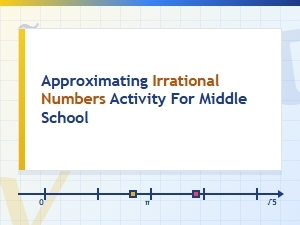 Mental Math Strategies for Approximating Irrational Numbers
 Mindful Estimation for Square Roots
 Square Root Estimation Challenge Without a Calculator
 Mastering Radicals: Mental Math Estimation Strategies
 Visual Estimation Diagrams for Radical Approximations
 Square Root Approximation Chart for Visual Estimation