Figuring out the square root of a number that isn't a perfect square feels impossible without a calculator. But square root estimation problems with integer approximations actually build a much deeper understanding of how numbers work. When you learn to estimate these values by hand, you stop relying on screens and start developing real number sense, which makes tackling more advanced algebra and geometry much easier later on.
What does it mean to estimate a square root to the nearest integer?
Estimating means finding the two whole numbers that your target square root falls between, and then deciding which one it is closest to. You do this by looking at perfect squares. For example, if you need to find the square root of 30, you look for the perfect squares closest to 30. Since 25 (which is 5 squared) and 36 (which is 6 squared) are the nearest perfect squares, the square root of 30 must be between 5 and 6. Because 30 is closer to 25 than to 36, the closest integer approximation is 5.
When do you actually need to do this without a calculator?
You usually run into these problems during standardized tests where calculators are banned, or in class when teachers want to check your foundational math skills. Learning how to approximate square roots for mental math tests gives you a huge advantage when you need to quickly eliminate wrong multiple-choice answers. It is also a great way to sanity-check your everyday work. If you calculate a side length on a geometry problem and get a strange decimal, a quick mental estimate tells you immediately if your answer is in the right ballpark.
How do you solve these problems step-by-step?
Getting the right answer comes down to a simple, repeatable process. Follow these steps every time:
- Memorize your perfect squares up to at least 144 (12 squared).
- Identify the two perfect squares your target number falls between.
- Take the square roots of those perfect squares to find your lower and upper bounds.
- Check which perfect square your target number is physically closer to on a number line.
If you want to get faster, you can practice estimation problems using mental math strategies to do this entirely in your head without writing down the bounds every single time.
What are the most common mistakes students make?
Even when students understand the basic concept, a few specific errors tend to pop up on homework and tests:
- Dividing by two instead of finding the root. A surprisingly common error is taking a number like 36 and dividing it by 2 to get 18, instead of recognizing the square root is 6.
- Misjudging the midpoint. Students often assume the exact midpoint between 5 and 6 is 30.5 (halfway between 25 and 36). While true mathematically, square roots do not scale perfectly linearly, which can sometimes throw off your closest-integer guess on edge cases.
- Forgetting larger perfect squares. If you only memorize up to 10 squared (100), you will get stuck on numbers like 130. You need to know that 11 squared is 121 and 12 squared is 144 to estimate higher numbers accurately.
How can teachers make this topic more engaging?
Staring at a worksheet full of radicals gets boring fast. To keep students engaged, it helps to use an approximating irrational numbers activity where they physically place square roots on a physical or drawn number line between whole numbers. This visual approach makes the abstract concept much easier to grasp. When you create materials for these lessons, typing them out in a friendly, readable typeface like Patrick Hand can actually make the worksheets feel a bit less intimidating for younger students.
Your practice checklist for mastering integer approximations
- Write down perfect squares from 1 to 225 (15 squared) on a flashcard and review it until you have them memorized.
- Pick five random non-perfect squares (like 40, 85, 110, 150, 200) and estimate their square roots to the nearest integer.
- Check your answers with a calculator to see how close your estimates were and adjust your mental midpoint logic if needed.
- Time yourself to see if you can estimate a square root in under five seconds without writing anything down.
 Quick Methods for Mentally Approximating Square Roots
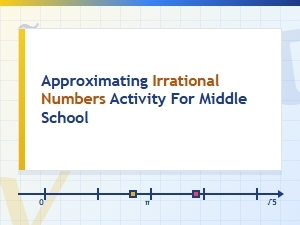 Mental Math Strategies for Approximating Irrational Numbers
 Square Root Estimation Challenge Without a Calculator
 Mastering Radicals: Mental Math Estimation Strategies
 Visual Estimation Diagrams for Radical Approximations
 Square Root Approximation Chart for Visual Estimation