Many students freeze when they see a radical symbol without a perfect square underneath. Memorizing a list of perfect squares only gets them so far. When they need to find the square root of 20 or 45, they need a way to visualize the math. An estimating square roots with visual aids lesson plan bridges this gap. It turns abstract numbers into physical areas and lengths, giving students a concrete way to understand where a radical falls on a number line.
What does it mean to estimate square roots visually?
Visual estimation relies on the geometric definition of a square root. The square root of a number is simply the side length of a square with that specific area. If a student needs to estimate the square root of 30, they draw or look at squares with areas of 25 (a 5x5 grid) and 36 (a 6x6 grid). By seeing that 30 is roughly halfway between 25 and 36, they can estimate the side length is about 5.5. This method moves the focus away from rote calculation and toward spatial reasoning.
When should teachers use visual models for radicals?
Introduce these models right after students master perfect squares but before they start using calculators for decimal approximations. It is the perfect bridge between basic arithmetic and irrational numbers. You can use area models and number lines to help students physically place these values in the correct order. This is especially useful when comparing values like the square root of 15 and the number 4, where students must visually realize that 4 is actually the square root of 16.
How do you structure the lesson for a middle school classroom?
Start with a quick review of perfect squares using grid paper. Have students draw squares with areas of 9, 16, and 25. Next, introduce a non-perfect square, like 20. Ask them to draw a shape that covers 20 unit squares, showing that it is slightly larger than a 4x4 grid but smaller than a 5x5 grid.
Once they grasp the concept, hand out a practice sheet with geometric grids so they can shade in the areas themselves. This hands-on shading reinforces that the area is not a perfect square, which naturally leads to a decimal side length.
What are the most common mistakes students make?
Even with visual aids, students can trip over a few specific conceptual hurdles. Watching out for these early saves time later.
- Dividing by 2 instead of finding the root: A student might see the square root of 20 and guess 10. Visual grids fix this immediately because a 10x10 square has an area of 100, which is visibly way too large.
- Assuming linear spacing: Students often think the square root of 30 is exactly 5.5 because 30 is halfway between 25 and 36. While 5.5 is a decent estimate, the actual value is closer to 5.47. Visual aids help show that the relationship between area and side length is not perfectly linear.
- Confusing side length with area: Some students will say the square root of 20 is 20. Having them physically trace the side of the 20-unit area square clears up this confusion instantly.
How can you support students who struggle with spatial reasoning?
Not every student naturally visualizes geometric areas. For these learners, provide a printed reference chart that lists perfect squares alongside their roots so they do not have to hold all the numbers in their working memory.
When creating your own teaching materials, readability is key. Using a clean, highly legible typeface like Nunito ensures that numbers and mathematical symbols do not blur together on the page, which is especially helpful for students with dyslexia or visual processing difficulties.
You can also use physical manipulatives. Give students 20 small square tiles and ask them to build the largest perfect square they can. They will build a 4x4 square using 16 tiles. The 4 leftover tiles visually prove that the side length must be a little more than 4.
What should students do after mastering visual estimation?
Once students can confidently estimate to the nearest tenth using grids and number lines, move them toward algebraic applications. They should start simplifying radicals, such as turning the square root of 20 into 2 times the square root of 5, and plotting these exact values on a coordinate plane. The visual foundation makes the transition to abstract algebra much smoother because they already understand what the numbers represent.
Lesson Prep Checklist
Use this quick list to make sure your classroom is ready for the activity:
- Print grid paper or geometric worksheets for every student.
- Prepare physical square tiles or load digital manipulatives on the smartboard for the introduction.
- Draw a large number line on the whiteboard spanning from 0 to 10.
- Write down three real-world scenarios where estimating a square root is necessary, such as finding the side length of a square garden with a specific area.
- Review the perfect squares up to 144 as a warm-up before starting the main visual activity.
 Visual Estimation Diagrams for Radical Approximations
 Square Root Approximation Chart for Visual Estimation
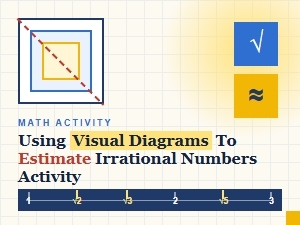 A Visual Guide to Estimating Irrational Numbers
 Visual Estimation Diagrams for Radicals Worksheets
 Quick Methods for Mentally Approximating Square Roots
 Mental Math Strategies for Approximating Irrational Numbers