Mastering irrational numbers starts with a solid grasp of approximation. When students use an estimating square roots worksheet with answers for students, they get immediate feedback that corrects misunderstandings on the spot. This practice builds the number sense required for higher-level algebra and geometry, moving them away from calculator dependency.
What does it mean to estimate a square root?
A square root asks which number, when multiplied by itself, equals the target value. For perfect squares like 16 or 25, the answer is a clean whole number. But most numbers are non-perfect squares. Estimating means finding the two whole numbers the root falls between, then narrowing it down to a decimal without relying on a device.
How do you approximate square roots without a calculator?
The most reliable method uses bounding perfect squares. Let us look at a practical example for the square root of 20.
- Identify the perfect squares just below and just above 20. Those are 16 and 25.
- Find the square roots of those bounding numbers. The square root of 16 is 4, and the square root of 25 is 5.
- Determine where 20 sits between 16 and 25. Since 20 is closer to 16, the square root will be closer to 4 than to 5.
- Make a reasoned guess, such as 4.4 or 4.5, and test it by multiplying 4.4 by 4.4 to see how close you get to 20.
Where can I find practice materials with visual aids?
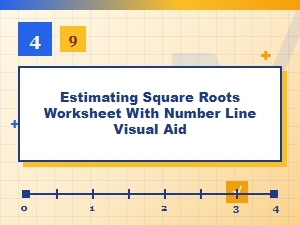
Visualizing the distance between numbers helps cement the concept of irrational numbers. Teachers often pair standard exercises with number line visual aids to help students map out approximation methods. Plotting the bounds and the estimated decimal on a physical line shows exactly where the value sits in relation to whole numbers.
What are the most common mistakes students make?
Even with clear instructions, students tend to fall into a few specific traps when calculating non-perfect roots.
- Dividing by two: Some students see the word square and mistakenly divide the number by 2 instead of finding the root.
- Skipping the bounds: Guessing a decimal without first establishing the lower and upper whole number limits leads to wild inaccuracies.
- Confusing squaring and rooting: Students might multiply 5 by 5 to check the square root of 5, rather than multiplying 2.2 by 2.2.
How should teachers and parents use the answer keys?
Answer keys are not just for assigning a final grade. They provide a roadmap for the expected logical steps. If you need targeted practice for younger teens, you can start with a middle school math worksheet focused on basic approximation methods. Once they grasp the basics, moving to an answer key that breaks down the specific approximation steps helps students self-correct their decimal placements and understand where their logic diverged from the correct path.
What is the best way to format these worksheets for the classroom?
Readability matters heavily in math materials. Crowded text and poor typography cause unnecessary cognitive load. Using a clean, rounded typeface like Fredoka makes mathematical symbols, radicals, and numbers easier for younger students to read without visual strain. Ensure there is plenty of white space between problems so students have room to write out their bounding steps.
Next steps for your math study session
Use this checklist to structure your next practice block:
- Review the list of perfect squares up to 144 before starting the worksheet.
- Complete five problems without looking at the answer key, writing out the bounding squares for each.
- Check your work against the provided solutions, focusing on the decimal placement rather than just the final digit.
- Redo any problem where your estimate was off by more than two-tenths.
 Estimating Square Roots Using Approximation Methods
 Mastering Square Roots with Guided Estimation Worksheets
 Visual Aids for Estimating Square Roots
 Mastering Square Roots with the Babylonian Method
 Quick Methods for Mentally Approximating Square Roots
 Visual Estimation Diagrams for Radical Approximations