Middle school is when math shifts from basic arithmetic to more abstract concepts, and estimating square roots is a major part of that transition. When students first encounter numbers like the square root of 20, they cannot just rely on memorized multiplication tables. They need to figure out where that value sits on a number line. Using an estimating square roots worksheet for middle school math gives students the focused practice required to build this specific type of number sense, helping them understand irrational numbers without getting stuck on endless decimals.
What does it mean to estimate a square root?
Estimating a square root means finding the two perfect squares that a given number falls between. For example, if a student needs to estimate the square root of 30, they look for the closest perfect squares: 25 and 36. Since the square root of 25 is 5 and the square root of 36 is 6, the square root of 30 must be somewhere between 5 and 6. Because 30 is closer to 25, the estimate would be around 5.4 or 5.5. Worksheets focused on this skill train students to do this mental math quickly and accurately.
When do students actually use this skill?
Students use this approximation skill constantly in geometry and algebra. When applying the Pythagorean theorem to find the hypotenuse of a right triangle, the answer is rarely a clean whole number. Estimating allows them to check if their final answer makes logical sense before they even touch a calculator. It also helps them plot irrational numbers on a number line, which is a standard requirement in eighth-grade math curriculums.
How should a good practice worksheet be structured?
A solid practice sheet starts simple and gradually increases in difficulty. It should begin with identifying the nearest perfect squares, then move to placing values on a number line, and finally introduce word problems. If you want to provide immediate feedback during a study session, using an estimating square roots worksheet with answers for students allows them to self-correct and understand their errors right away.
For students who need a more structured breakdown of the approximation process, a step-by-step estimating square roots worksheet breaks the mental math down into manageable, written stages. This prevents them from feeling overwhelmed when tackling larger numbers.
What are the most common mistakes students make?
The most frequent error is dividing the number by two instead of finding the square root. A student might see the square root of 16 and write 8. This happens when they confuse the operation of squaring a number with multiplying it by two.
Another common issue is poor number line placement. Students might correctly identify that the square root of 40 is between 6 and 7, but then place it exactly in the middle without realizing that 40 is much closer to 36 (which is 6 squared) than to 49 (which is 7 squared).
Are there advanced methods for older or advanced middle schoolers?
Yes. Once students master the basic number line estimation, you can introduce them to historical algorithms. The Babylonian method, also known as Heron's method, uses division and averaging to get a highly accurate decimal approximation. Teachers looking to challenge their advanced students can use an estimating square roots worksheet using the Babylonian method to show them how mathematicians calculated these values long before calculators existed.
How can teachers and parents make the practice more engaging?
The visual layout of a math worksheet actually impacts how a student approaches it. Dense, cluttered pages cause math anxiety. Using a clean, readable, and slightly informal typeface can make the page look less intimidating. Many educators prefer using a handwritten-style font like Patrick Hand for middle school materials because it feels more approachable than standard Times New Roman.
Beyond formatting, tie the problems to reality. Ask them to estimate the length of a diagonal walkway across a rectangular park, or figure out the side length of a square garden given its total area. Context makes the abstract numbers mean something.
Next steps for your next math lesson
Before handing out your next worksheet, run through this quick checklist to ensure your students are set up for success:
- Review the perfect squares from 1 to 144 (1 squared up to 12 squared) as a quick warm-up.
- Ensure students know the difference between squaring a number and finding its square root.
- Start the worksheet with two or three guided examples on the board.
- Have students use a different colored pen to mark the perfect squares on their number lines.
- Allow them to check their first five answers with a partner before moving on to the rest of the page.
 Estimating Square Roots: Worksheet and Practice Problems
 Mastering Square Roots with Guided Estimation Worksheets
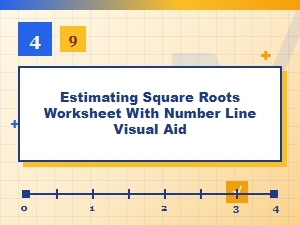 Visual Aids for Estimating Square Roots
 Mastering Square Roots with the Babylonian Method
 Quick Methods for Mentally Approximating Square Roots
 Visual Estimation Diagrams for Radical Approximations