Learning to estimate square roots without a calculator builds a solid foundation for algebra and geometry. Finding the right estimating square roots worksheet step by step problems can make a huge difference in how quickly students grasp irrational numbers. This skill stops learners from blindly trusting a calculator and helps them understand the real size and proportion of a value.
What Does It Mean to Estimate a Square Root?
Estimating a square root means finding the two closest perfect squares that trap your target number. If you need to find the square root of 20, you look for the perfect squares just below and just above it. Since 16 and 25 are perfect squares, you know the answer is between 4 and 5. Step-by-step worksheets break this logic down so students can see the progression from identifying perfect squares to narrowing down the decimal.
When Do Students Actually Need This Skill?
Teachers usually introduce this topic in pre-algebra or eighth-grade math. It becomes highly relevant when students start using the Pythagorean theorem to find the hypotenuse of a right triangle. If the sides are 3 and 4, the hypotenuse is exactly 5. But if the sides are 2 and 3, the hypotenuse is the square root of 13. Knowing how to approximate that value mentally helps students check if their final answer makes sense. For younger learners, practicing with a tailored middle school math worksheet makes these abstract concepts much more concrete.
How Do You Solve These Problems Step by Step?
Let us walk through a standard problem, like estimating the square root of 40 to the nearest tenth.
- Identify the perfect squares closest to 40. These are 36 (which is 6 squared) and 49 (which is 7 squared).
- Determine the whole number range. The square root of 40 must be between 6 and 7.
- Figure out the fraction or decimal. Since 40 is closer to 36 than it is to 49, the answer will be closer to 6. A good estimate is 6.3 or 6.4.
When students need more structured practice, working through specific approximation methods helps them master this exact sequence without getting lost in the arithmetic.
What Are the Most Common Mistakes Students Make?
Even with clear instructions, students tend to fall into a few predictable traps when approximating roots.
- Dividing by two: Some students see "square root of 20" and immediately write 10. Remind them that a square root asks what number multiplied by itself gives 20.
- Skipping the number line: Just writing "between 4 and 5" is not always enough. Plotting the value visually prevents spatial reasoning errors. Using a worksheet with a visual aid forces students to physically mark the spot on the line, which solidifies their understanding of distance.
- Rounding too early: When estimating to the nearest tenth, students sometimes round the perfect squares instead of the final decimal, which throws off their final answer.
How Can Teachers and Parents Make Practice More Effective?
Rote memorization of perfect squares up to 225 (15 squared) saves a lot of time. Create flashcards or quick daily quizzes for these baseline numbers so students do not have to calculate them from scratch every time. When designing or printing practice sheets, keep the layout clean and uncluttered. If you are creating your own custom materials, choosing a highly legible typeface like Montserrat ensures that numbers and mathematical symbols are easy to read at a glance.
A Practical Checklist for Your Next Math Session
Before moving on to complex algebraic equations, make sure the student can complete the following tasks confidently:
- Recite perfect squares from 1 to 225 without hesitation.
- Complete three step-by-step estimation problems entirely without a calculator.
- Plot the estimated answers accurately on a physical number line.
- Use a calculator to find the exact decimal and compare it to the manual estimate.
- Identify the margin of error and explain why the estimate was slightly high or low based on the distance between perfect squares.
 Estimating Square Roots: Worksheet and Practice Problems
 Estimating Square Roots Using Approximation Methods
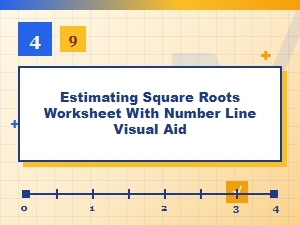 Visual Aids for Estimating Square Roots
 Mastering Square Roots with the Babylonian Method
 Quick Methods for Mentally Approximating Square Roots
 Visual Estimation Diagrams for Radical Approximations