Finding the square root of a non-perfect square without a calculator often frustrates students. The Babylonian method, also known as Heron's method, turns this guessing game into a reliable, repeatable process. Using an estimating square roots worksheet using the babylonian method gives learners the structured space they need to practice the guess, divide, and average steps until the concept clicks. It builds strong number sense and helps students understand what a radical expression actually represents, rather than just pushing buttons on a device.
How does the Babylonian method actually work?
The algorithm relies on a simple loop of arithmetic. You start with a reasonable guess, divide the original number by that guess, and then average the two numbers to get a better guess.
For example, if you want to estimate the square root of 10:
- Guess a number close to the root. Since 3 squared is 9, guess 3.
- Divide 10 by 3 to get 3.33.
- Find the average of 3 and 3.33, which is 3.165.
- Repeat the process using 3.165 as your new guess until the decimal stops changing.
This iterative approach converges very quickly, usually yielding a highly accurate decimal after just two or three rounds.
When should students use this approximation technique?
Middle schoolers often encounter radical expressions before they fully grasp algebra. Working through structured approximation exercises helps them visualize the distance between perfect squares. It also prepares them for higher-level math where estimating values quickly is necessary to check if a calculator answer makes sense. Teachers usually introduce this during units on irrational numbers or right triangle geometry.
What makes a practice worksheet effective?
Space matters when doing long division and averaging by hand. When designing or selecting grade-level math worksheets, look for pages that provide dedicated boxes for the initial guess, the division step, and the final average. This keeps the work organized and makes it much easier to spot where a calculation went wrong. A cluttered page leads to sloppy arithmetic.
Where do students usually make calculation mistakes?
The most frequent error happens when students round their division quotient too early. If they round 3.333 to 3 before averaging, the final estimate loses accuracy. Another common issue is forgetting to divide the sum by two when finding the average. Providing guided step-by-step problems reduces these errors by forcing students to write out every single part of the formula before moving to the next iteration.
How can you format the worksheet for better readability?
Typography matters in math materials. Choosing a clean, highly legible typeface like Montserrat ensures that numbers and decimal points don't blur together on the page. You can also review a detailed Babylonian method explanation to ensure your worksheet examples align with standard teaching practices. Keeping plenty of white space between problems prevents visual fatigue during longer practice sessions.
What should you do before the next practice session?
Set up the environment to make the math practice as smooth as possible. Follow this quick checklist before handing out the worksheets:
- Verify that the target numbers are not perfect squares, as those do not require estimation.
- Ensure students have scratch paper available for the long division steps.
- Review how to find the average of two decimals, as this is where most arithmetic errors occur.
- Decide on a stopping rule, such as rounding to the nearest hundredth after the second iteration.
 Estimating Square Roots: Worksheet and Practice Problems
 Estimating Square Roots Using Approximation Methods
 Mastering Square Roots with Guided Estimation Worksheets
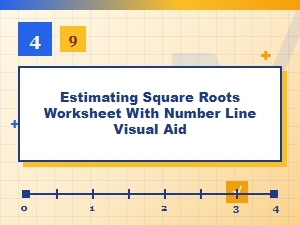 Visual Aids for Estimating Square Roots
 Quick Methods for Mentally Approximating Square Roots
 Visual Estimation Diagrams for Radical Approximations